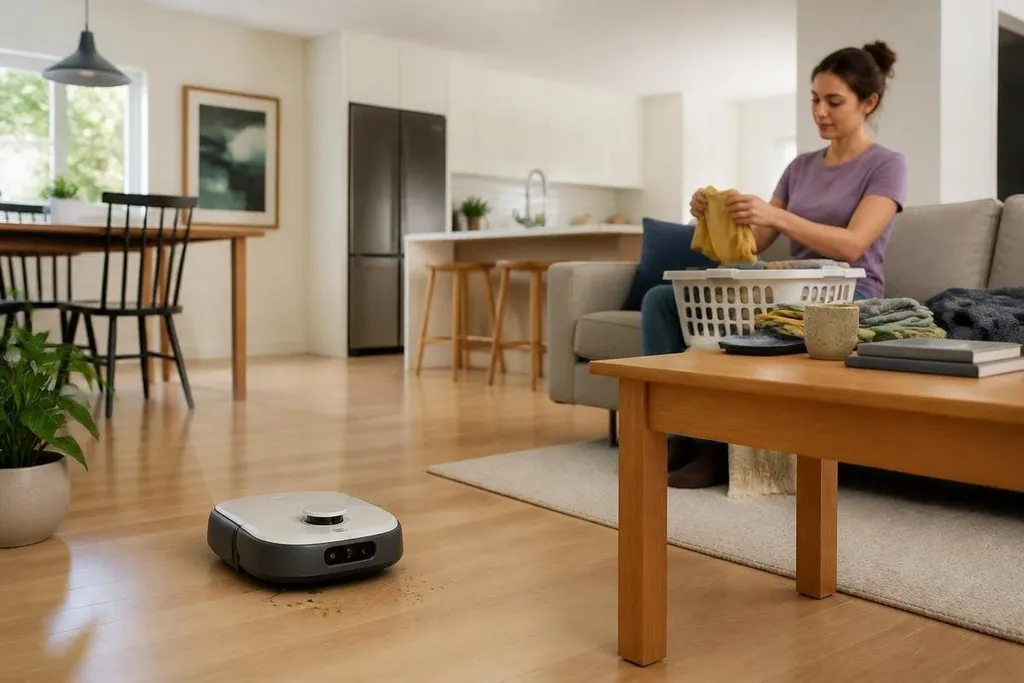
A home robot won't become common because it can wave, talk, or carry out a polished demo. It will become common when it handles one daily task safely, works around people, and costs less trouble than the task it replaces.
- Buyers need a clear job for the robot before they need a long feature list.
- Safety must cover children, pets, stairs, doors, and dropped objects.
- The business case depends on the full cost of ownership, not the purchase price alone.
Start with one useful job
Home robots need a narrow first job. Cleaning a floor, moving laundry, checking an empty house, or bringing an object across a room gives the buyer a way to judge success.
That job also sets the hardware needs. A floor-cleaning robot can stay low and follow planned routes. A robot that carries objects needs balance, a safe gripper, space to turn, and a way to tell whether it has picked up the right thing.
A broad promise creates a harder test. If a robot claims to help with every household task, you have to learn its limits one task at a time. A focused product gives you a simple question: did it do the job without needing constant help?
A household robot has to deal with dropped objects, narrow paths, and people crossing its route. Robot 24 reports can show the task, room layout, test length, and moments when a person had to step in. That evidence leads into safety in an untidy house.
Safety has to work in an untidy house
A home is not a factory floor. Toys move, bags land in walkways, pets change direction, and people open doors without warning. A useful home robot must sense these changes and respond at a safe speed.
That requires more than cameras. The robot needs ways to detect contact, stop its motors, protect fingers, and avoid pulling on cables.
It also needs a manual stop that people can reach without searching through an app. The software has a hard job too: it must know when it has lost its position, when an object is unsafe to lift, and when a person has taken over the task.
A confident voice response cannot fix a robot that keeps moving after a child steps into its path.
Trust grows through repeatable behavior. The robot should stop for the same hazard every time, explain the problem in plain words, and wait for a person when it cannot judge the situation.
The price includes the work around the robot
The purchase price tells only part of the story. Buyers also need to count setup, repairs, batteries, software fees, replacement parts, and the time spent correcting mistakes.
A robot may save effort on one task and add work elsewhere. If it needs a cleared room, careful charging, and daily checks, the owner may still prefer a simpler appliance. That does not make the robot useless. It shows where the product fits.
Privacy will shape the price people are willing to pay. Cameras and microphones can make a robot more useful, but the owner needs control over stored data, remote access, and software updates. Those controls should be visible before purchase, not buried in a long agreement.
I’d wait to buy a general home robot until its maker publishes repair costs, support terms, and the tasks it cannot do.
What would make a buyer say yes?
A product can earn a place in the home if its maker answers practical questions before the sale. Use this checklist when comparing a robot:
- Named task: Can you state the job in one sentence?
- Failure behavior: Does it stop safely when the room changes?
- Human control: Can someone pause or stop it without an app?
- Repair plan: Are parts, service, and battery replacement explained?
- Data control: Can you delete recordings and block remote access?
- Daily effort: How much setup and correction does the task require?
These answers matter more than a long list of sensors or a smooth conversation with the robot. A machine that completes one household job every day has a clearer path to trust than one that promises a dozen jobs and needs help with each one.
The first home robots to become common will probably look modest. They will repeat a small task, handle ordinary mistakes, and show their limits before the owner finds them the hard way.